Hospital OS vs ERP vs HIS vs EHR: A Decision Guide for 2026
Cut through the acronym noise. Compare hospital OS, ERP, HIS, and EHR by what they actually control — and which architecture fits your hospital in the US, UK, EU, or India.
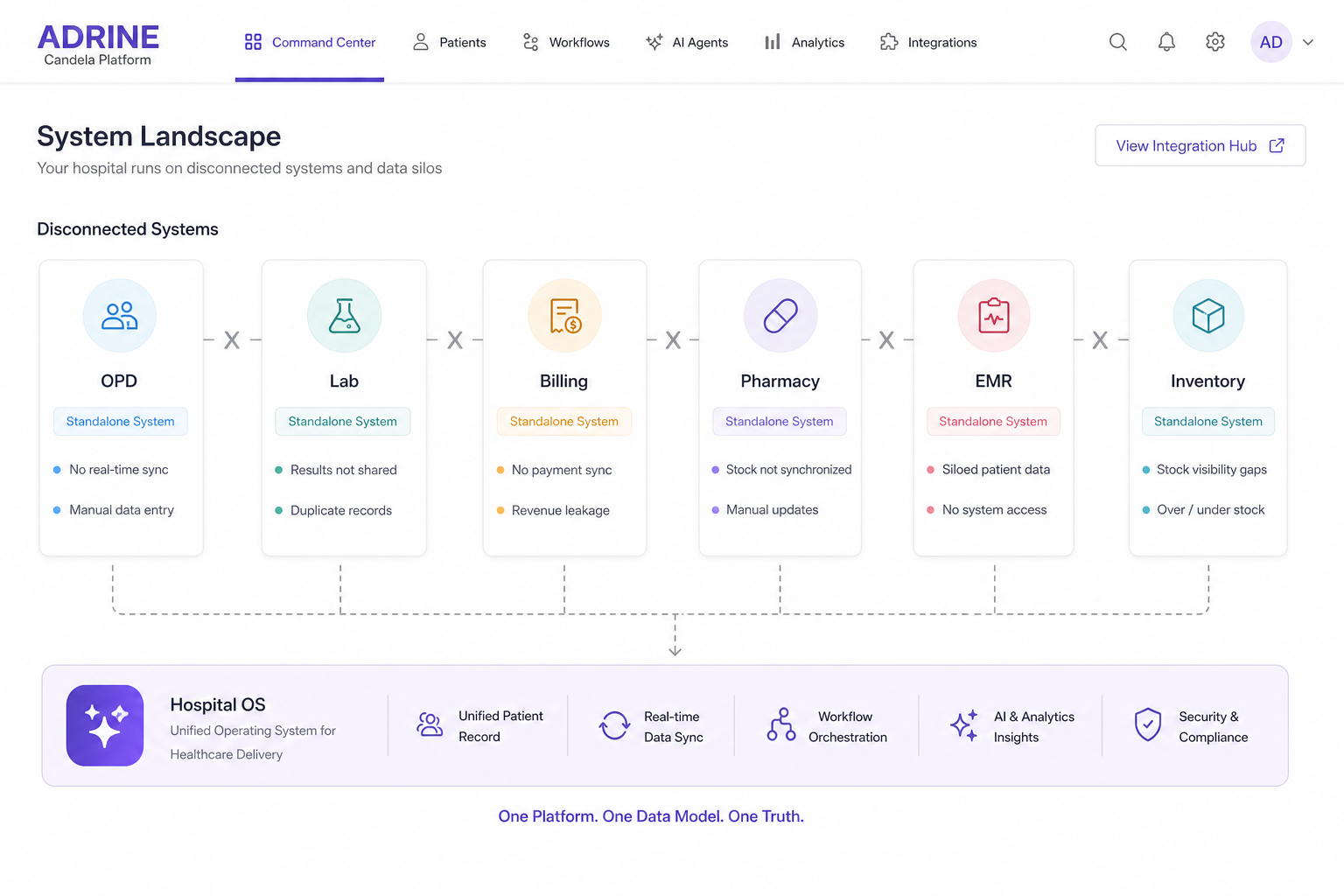
Hospital software acronyms are not a taxonomy — they are a marketing landscape. Vendors swap labels freely. A product called HMS may include lab and pharmacy. An HIS may lack payroll. An EHR may not include billing. The only question that matters: does your hospital run on one live system or a federation of partial tools?
Definitions that hold up in procurement
HMS — Hospital Management System
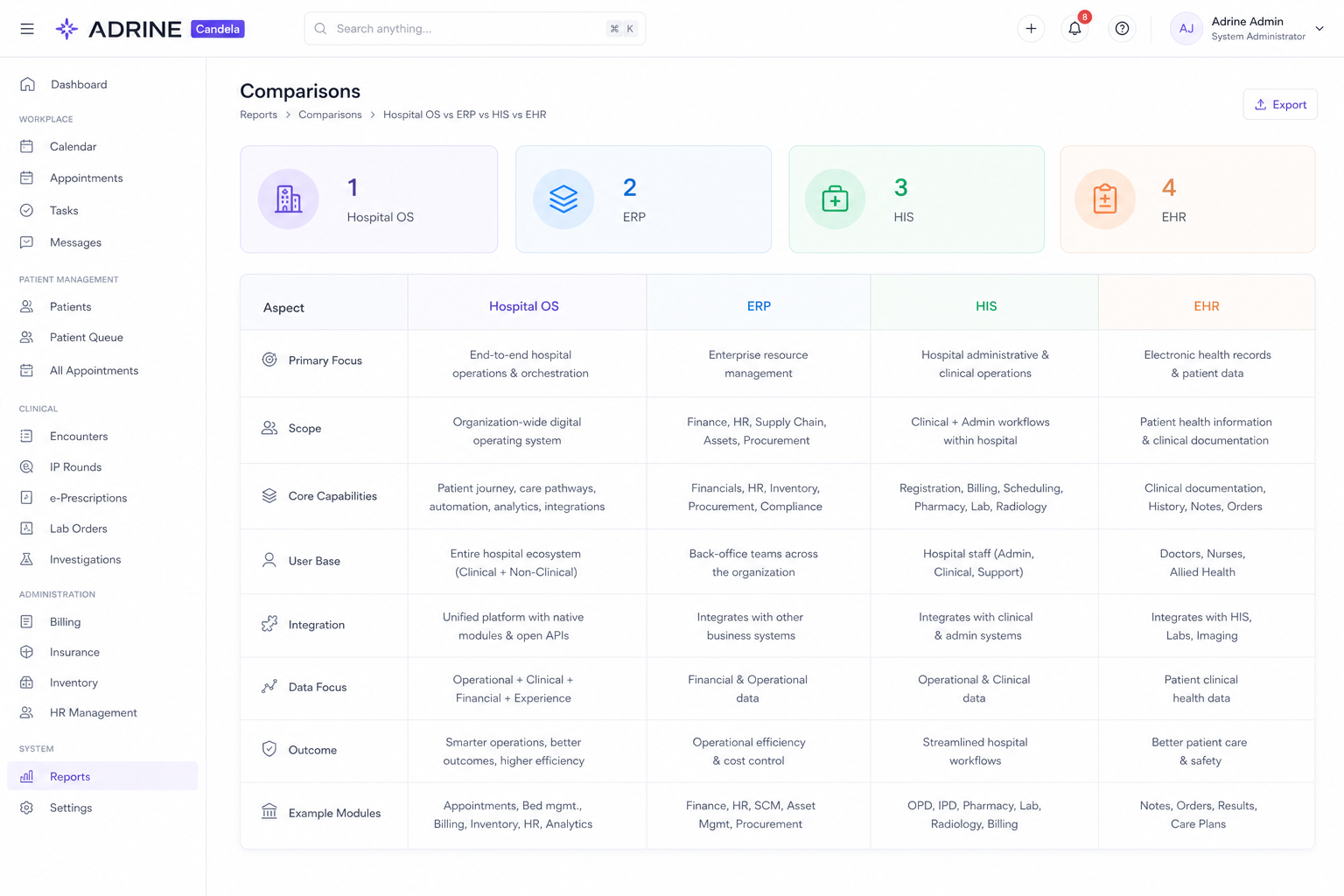
Traditionally the administrative core: registration, appointments, bed census, billing, and basic reports. Strong for single-department digitization. Weak when clinical, lab, and finance teams each use a different database.
HIS — Hospital Information System
The European and UK-preferred umbrella term. Implies clinical plus administrative coverage — outpatient, inpatient, nursing, diagnostics, pharmacy. Quality depends entirely on implementation depth; the label alone guarantees nothing.
Hospital ERP
Extends into enterprise functions: procurement, inventory, HR, payroll, fixed assets, multi-entity consolidation. Common in large groups. Often heavy to implement and still may not fix front-line clinical fragmentation if modules were acquired separately.
EHR — Electronic Health Record
Clinical documentation and orders — the US-centric term shaped by Meaningful Use and HIPAA. Strong for physician workflows. Rarely solves revenue cycle, queue management, or hospital-wide operations without additional systems.
Hospital OS — Hospital Operating System
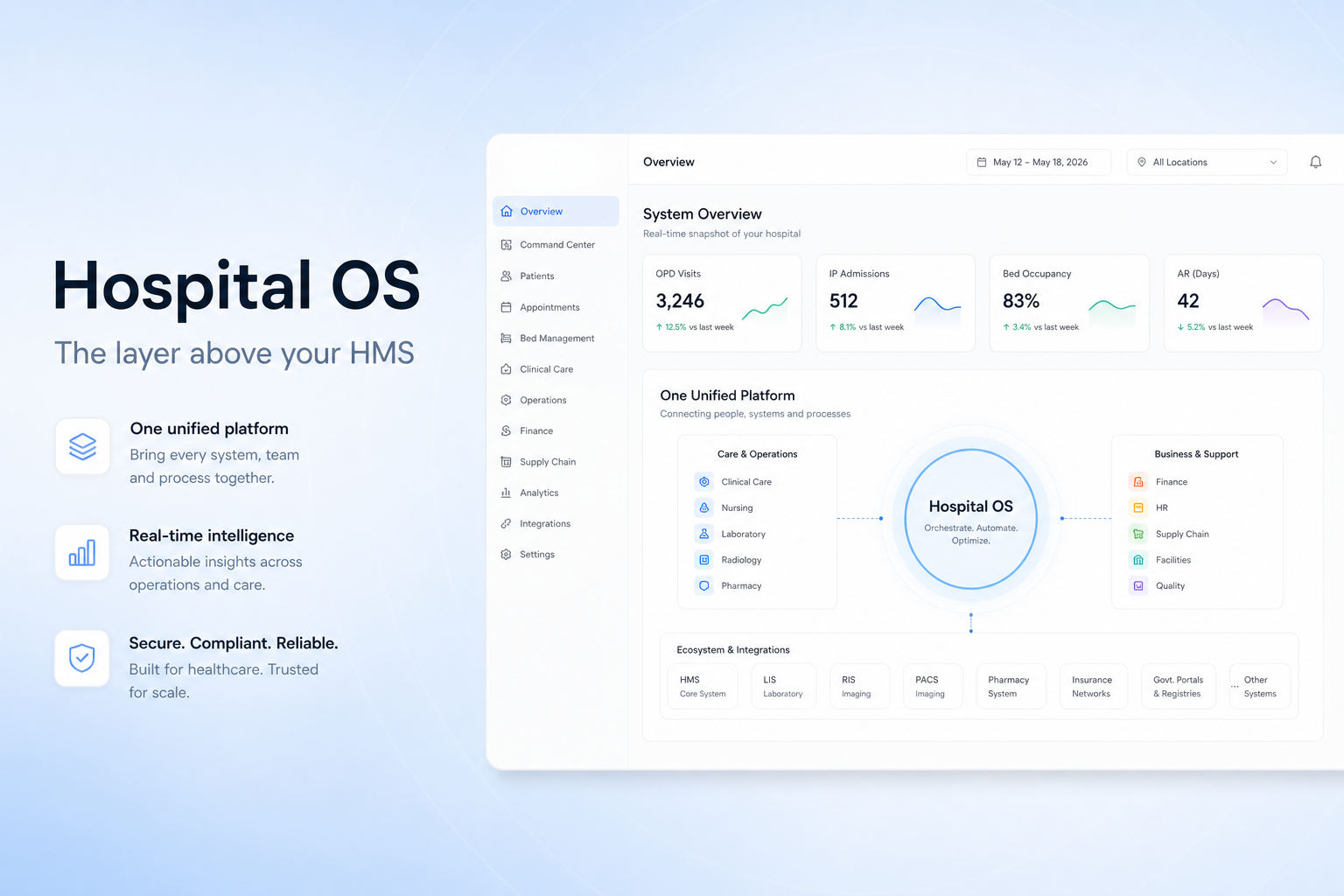
The emerging category Candela defines: one cloud platform where clinical, financial, and operational events share a patient record, and leadership consumes intelligence from seven layers — financial, workforce, operations, strategic, revenue cycle, clinical, and procurement — in one command center.
Overlap map: what each layer actually controls
- Patient registration and master index — HMS, HIS, Hospital OS
- Clinical notes and orders — HIS, EHR, Hospital OS
- Lab and imaging workflows — HIS, Hospital OS (not core ERP)
- Billing and claims — HMS, ERP, Hospital OS
- Procurement and HR — ERP primarily
- Real-time leadership KPIs — Hospital OS primarily
Regional buying language (SEO reality)
US procurement teams search hospital management software and revenue cycle management. UK trusts and private groups search hospital information system and patient pathway software. EU hospitals add GDPR and EHDS readiness. Indian hospitals search HMS, HMIS, and ABDM integration. Your RFP should translate acronyms into required workflows — not accept vendor labels at face value.
Decision matrix by hospital profile
50–100 beds, single site
Choose a hospital OS or deep HMS that natively includes OPD, IPD, lab, pharmacy, and billing. Skip full ERP until you have a second legal entity or centralized procurement pain.
100–300 beds, multi-specialty
Prioritize unified patient record and command center. Evaluate whether ERP modules are included or whether you are buying integration risk.
Multi-branch groups
Hospital OS with group dashboard plus selective ERP functions (HR, procurement). Insist on one patient ID and consolidated revenue visibility.
Three questions to ask every vendor
- When a lab result is finalized, how many seconds until it appears in nursing and billing without an interface?
- Can your CEO see bed occupancy, collections, and OPD wait time on one screen without a report request?
- What breaks if we disable your integration middleware for one day?
The right architecture in 2026 is not the longest acronym. It is the shortest path from patient arrival to accurate revenue — with leadership visibility the entire way.
Frequently asked questions
- What is the difference between HIS and hospital OS?
- A hospital information system (HIS) is a broad label for clinical and administrative software. A hospital OS is an architecture: one cloud platform where every module shares a live patient record and leadership intelligence layer. Not every HIS is a hospital OS.
- Is hospital ERP the same as EHR?
- No. EHR (electronic health record) focuses on clinical documentation — notes, orders, results. Hospital ERP extends into finance, HR, procurement, and inventory. A hospital OS typically includes EHR-like clinical workflows plus operations and intelligence without requiring a separate ERP.
- What should a 200-bed hospital buy in 2026?
- A 200-bed hospital should prioritize a unified platform with OPD, IPD, lab, pharmacy, billing, and a leadership dashboard. Buy ERP extensions only if you need centralized procurement and HR across multiple legal entities.