The 7 Intelligence Layers of a Modern Hospital OS
Financial, workforce, operations, strategic, revenue cycle, clinical, and procurement — how each layer feeds one hospital command center for global leadership teams.
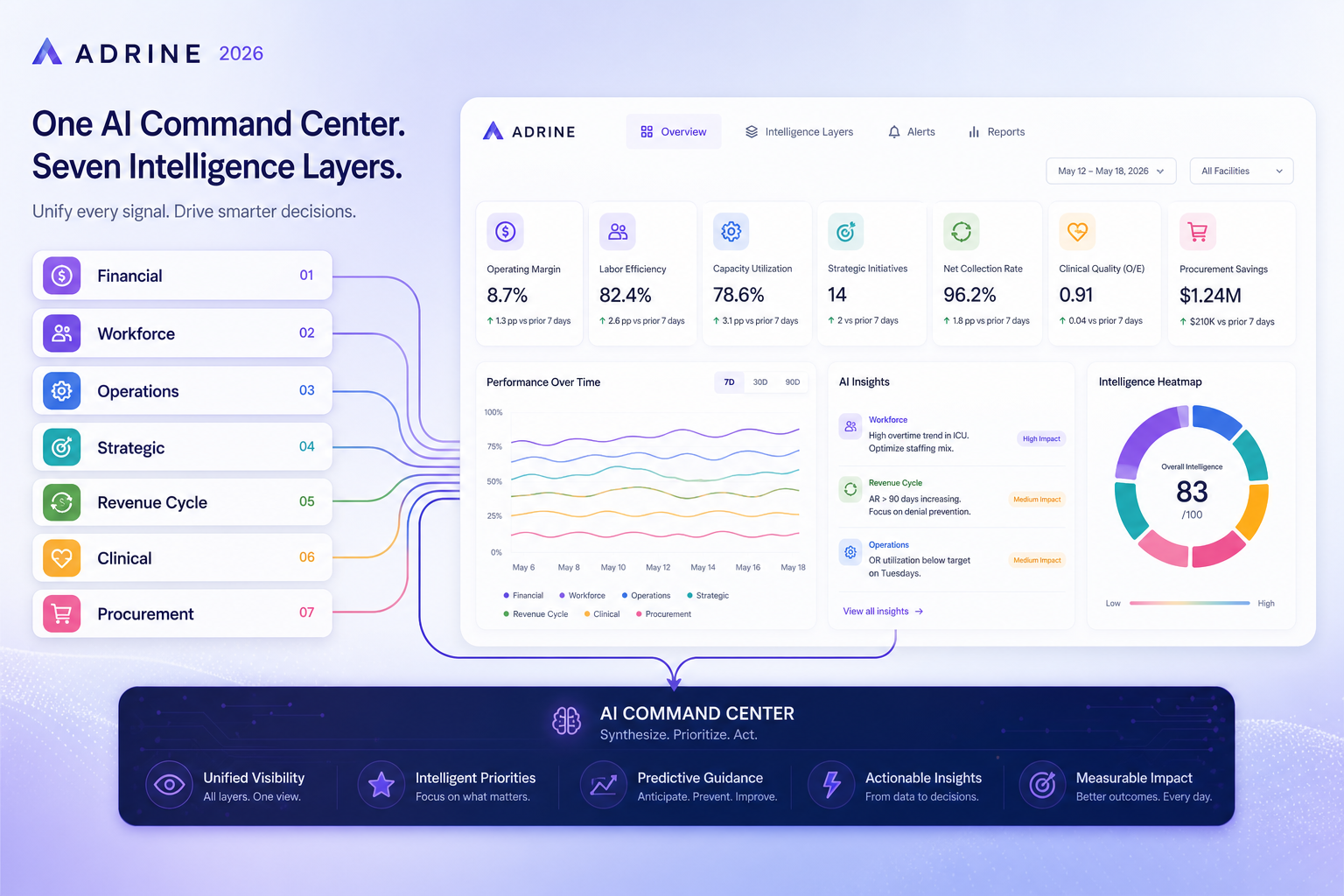
Dashboards tell you what happened. A hospital OS tells you what is happening and what will break next. That difference is why modern platforms organize intelligence into layers — each aligned to a role that already exists in your hospital, each reading the same live patient and operations record.
Layer 01 — Financial (CFO)
Revenue leakage scans, cash collection forecasts, and daily financial digests without exporting to Excel. The layer watches charge capture lag, package variance, and payer mix drift — critical for US RCM teams and India TPA-heavy hospitals alike.
Layer 02 — Workforce (HR)
Attendance anomalies, shift coverage gaps, attrition risk signals, and payroll integrity checks. Nursing shortages appear here before they become ward incidents.
Layer 03 — Operations (COO)
OPD load, bed forecasts, emergency surges, wait-time bottlenecks, and stock-out warnings. This is the patient flow layer UK and NZ hospitals search for under pathway and queue language.
Layer 04 — Strategic (CEO)
Catchment mapping, competitor benchmarks, and service-line opportunities. Leadership sees where to invest beds, specialties, or outreach — not only last quarter's PDF.
Layer 05 — Revenue Cycle (Billing)
Live collections, aging priority queues, prior-auth prediction, and billing error checks. US hospitals reduce denials; Indian hospitals accelerate cashless finalization.
Layer 06 — Clinical (Quality)
Outcome tracking, drug interaction flags, critical lab escalations, and length-of-stay prediction. Supports Joint Commission, CQC, and NABH evidence without a separate audit project.
Layer 07 — Procurement (Supply)
Auto-reorder signals, expiry risk, consumption anomalies, and vendor scoring. Stops theatre delays caused by inventory blind spots.
Where layers converge: the AI command center
Layers only matter if leadership does not need seven logins. A hospital OS collapses them into one morning briefing — collections, occupancy, queues, staff, and alerts ranked by urgency before 8 AM.
Implementation order that works
- Operations + revenue cycle — immediate visibility and cash impact
- Clinical + workforce — quality and staffing stability
- Financial + procurement — margin and supply resilience
- Strategic — once 90 days of clean unified data exists
Hospitals that treat AI as seven disconnected chatbots fail. Hospitals that treat intelligence as seven layers on one OS compound gains every week.
Frequently asked questions
- What are hospital intelligence layers?
- Intelligence layers are domain-specific AI and analytics modules — finance, workforce, operations, strategy, revenue cycle, clinical quality, and procurement — that monitor live hospital data and surface alerts in one command center.
- How is this different from a hospital BI dashboard?
- Traditional BI dashboards show historical charts. Intelligence layers watch live workflows, predict bottlenecks, and push role-specific briefings — for example revenue leakage scans for the CFO and wait-time alerts for the COO.
- Can hospitals enable only some layers?
- Yes. A hospital OS should let you activate layers by maturity — operations and revenue cycle first, strategic and procurement as data quality allows — without buying separate AI products per department.