What Is a Hospital OS? The Layer Above Your HMS
A hospital operating system unifies clinical, financial, and operational workflows on one live record — for hospitals in the US, UK, EU, India, and New Zealand.
Most hospitals do not have a software problem. They have a fragmentation problem. Registration runs on one system, nursing on another, lab results arrive by email, billing reconciles in Excel, and the CEO gets a PDF every Monday. Each tool works. Together, they slow decisions, leak revenue, and bury staff in duplicate entry.
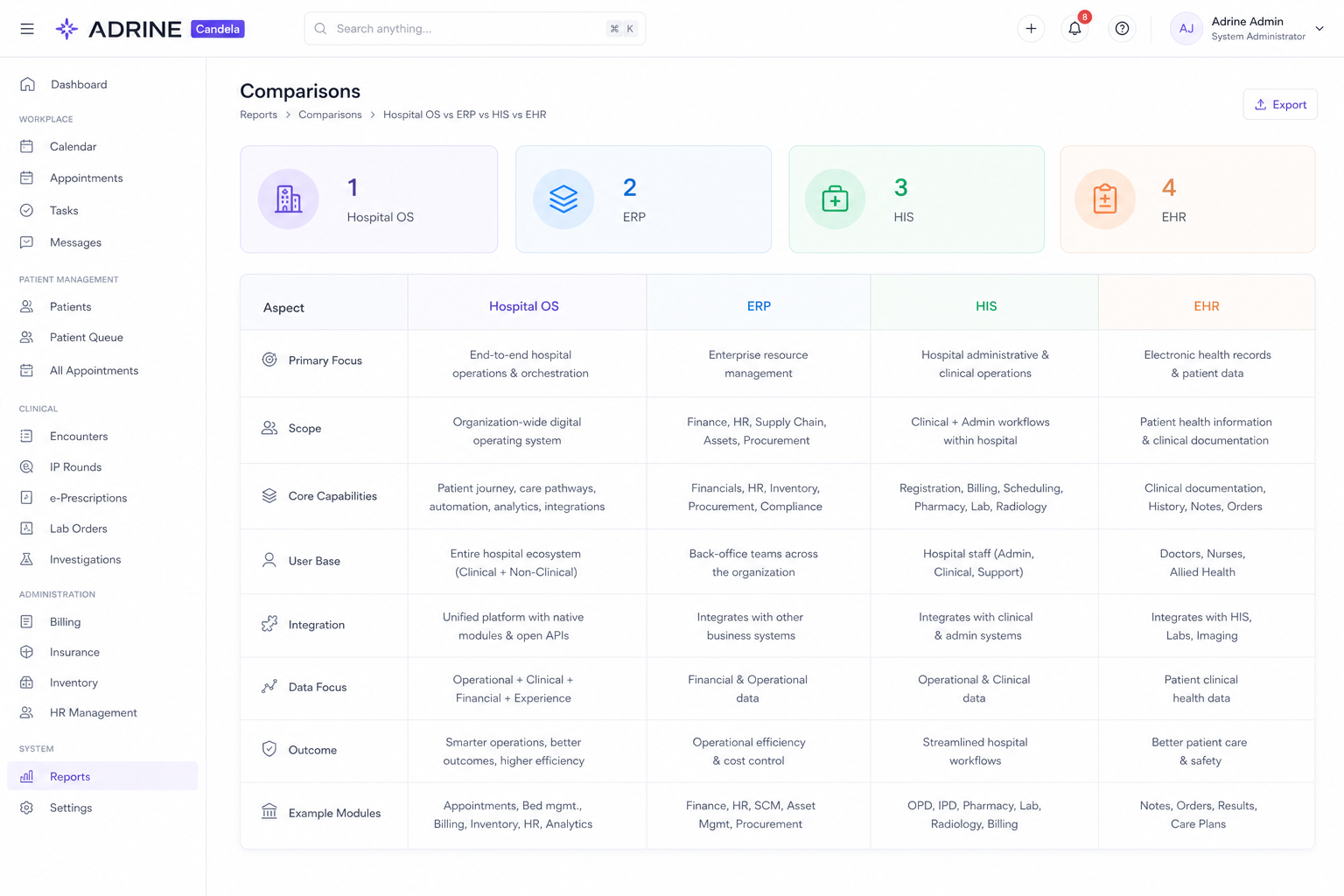
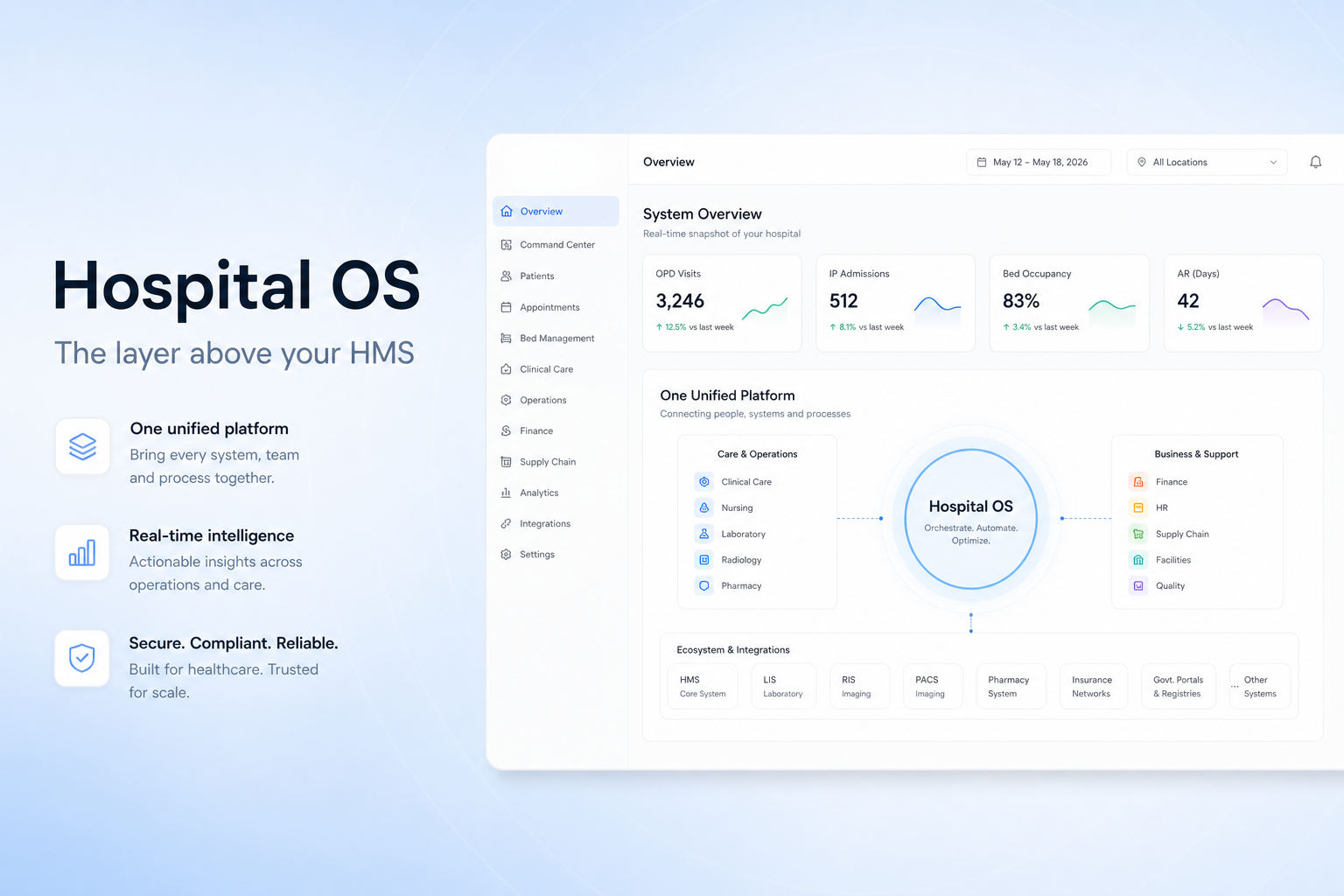
A hospital operating system — Hospital OS — is the category above your HMS, HIS, or ERP. It is not another module. It is the layer that connects every department to one record, one queue, one billing truth, and one morning briefing. Whether you run a 50-bed clinic in Auckland, a private hospital in London, or a 300-bed multi-specialty centre in Mumbai, the underlying failure mode is the same: disconnected systems pretending to be one hospital.
What a hospital OS actually does
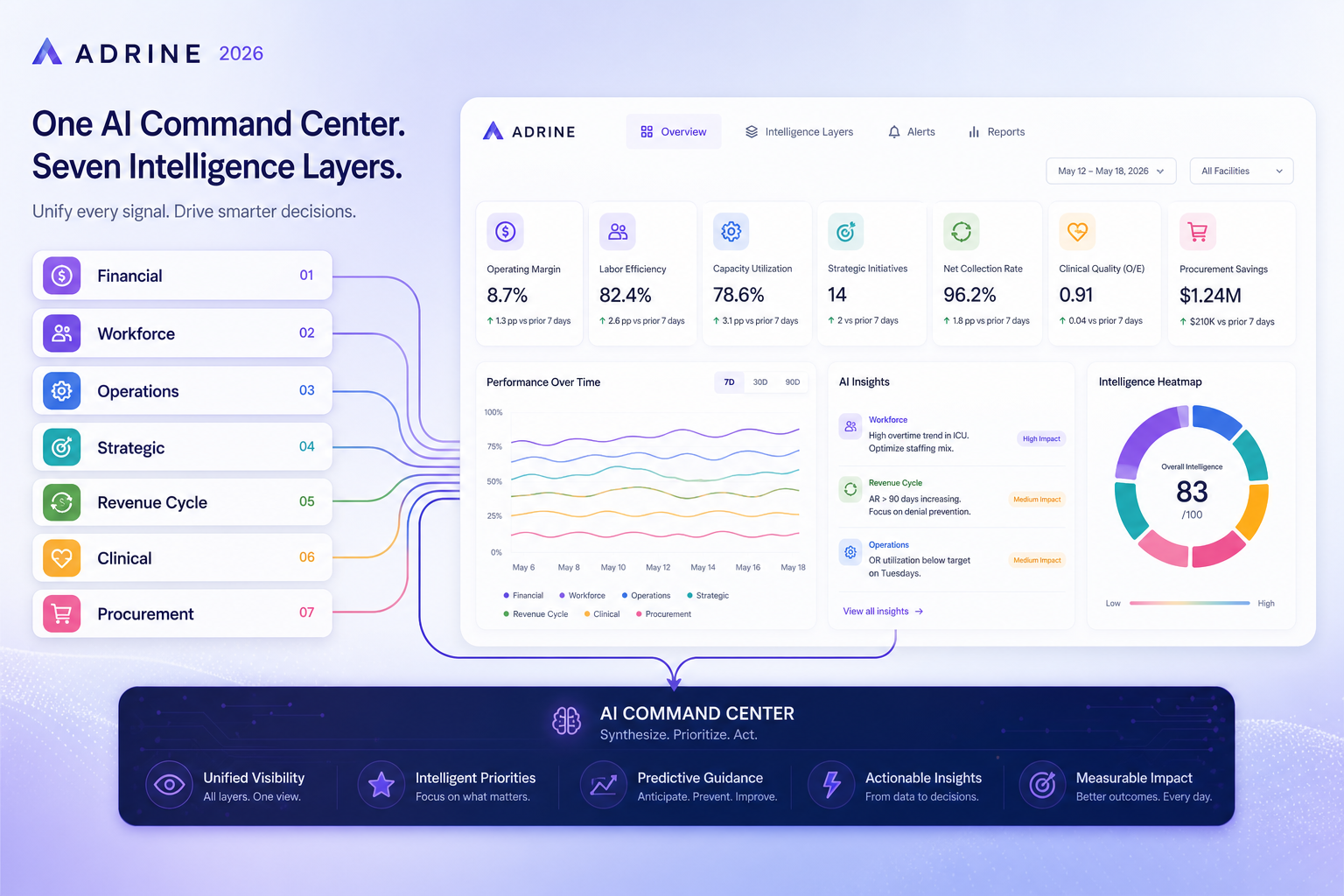
Think of three planes. The data plane is the live patient record — demographics, encounters, orders, results, medications, and charges updating in real time. The workflow plane is how staff move patients through OPD queues, ward rounds, theatre schedules, discharge, and claims. The intelligence plane is what leadership sees without requesting reports: bed occupancy, collections, wait times, stock-outs, and clinical alerts in one command center.
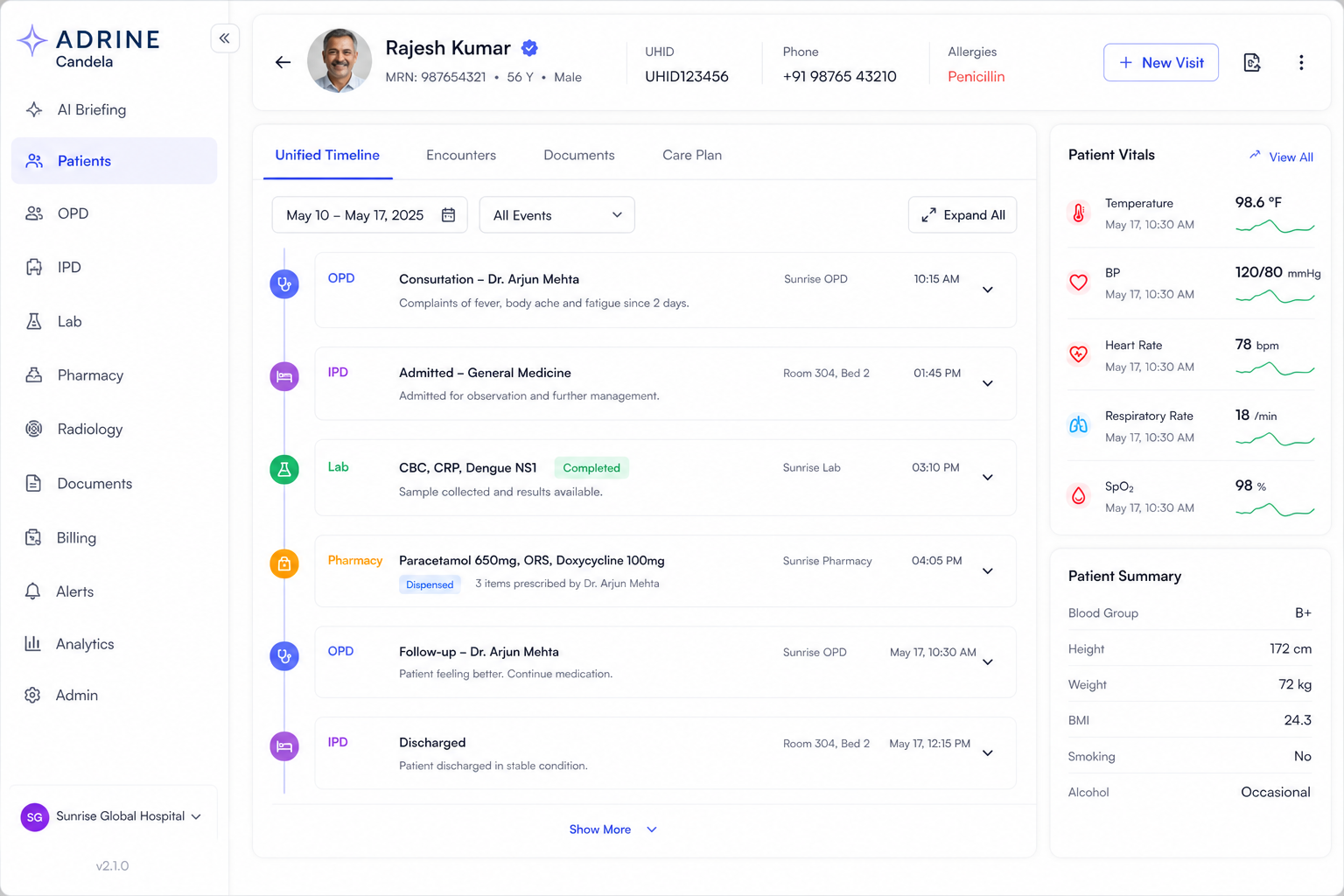
- One patient timeline across outpatient, inpatient, emergency, lab, imaging, and pharmacy
- Department workflows that write to the same record — no overnight sync jobs
- Revenue and insurance workflows embedded in clinical events, not bolted on after discharge
- Role-based intelligence for CFO, COO, nursing, and quality — not 40 static MIS exports
- Cloud-native security with audit trails aligned to HIPAA (US), GDPR (EU/UK), and local privacy law
Hospital OS vs the labels you already know
Buyers in different markets use different language. India searches for HMS and HMIS. The United States searches for hospital management software and revenue cycle management. The United Kingdom and Europe search for hospital information systems. Vendors often use these terms interchangeably. The label matters less than whether the platform behaves as one operating system or six products duct-taped together.
When you still need an HMS — and when you have outgrown it
A standalone HMS is enough when a single department digitizes first — billing-only, or OPD-only. You have outgrown it when leadership cannot answer basic questions without a meeting: What is our real-time bed position? Where did we leak revenue yesterday? Which queue is breaching wait-time targets? A hospital OS answers those questions from live data, not month-end reports.
Who should evaluate a hospital OS in 2026
- Multi-specialty hospitals adding departments faster than integrations can follow
- Groups running multiple branches that need one patient identity and one financial truth
- US hospitals fighting denials and prior-auth friction across disconnected billing and clinical tools
- UK and EU providers preparing for tighter data governance and cross-border record exchange
- Indian hospitals scaling on ABDM without rebuilding registration and discharge workflows
- NZ and Australian providers modernizing patient flow under Privacy Act and HIPC requirements
What to look for in a credible hospital OS
- Single live patient record across clinical and financial events
- Native outpatient and inpatient queue management with real-time visibility
- Embedded revenue cycle or billing that matches your market (RCM in the US, NHS tariffs in the UK, GST and TPA in India)
- Leadership command center with configurable KPIs — not only report builders
- API-ready interoperability (HL7 FHIR, ABHA in India) without a separate integration project per department
- Implementation measured in weeks with parallel run, not multi-year rip-and-replace
The hospitals that win the next decade will not buy more software. They will collapse complexity into one operating layer — and give leaders a live picture of the institution before the day starts. That is what a hospital OS is for.
Frequently asked questions
- What is a hospital operating system?
- A hospital operating system (Hospital OS) is a cloud platform that runs every department — outpatient, inpatient, pharmacy, lab, billing, and leadership intelligence — on one live patient record. It sits above traditional HMS or HIS modules and adds operational intelligence, not just data entry.
- How is a hospital OS different from an HMS?
- An HMS (hospital management system) typically automates departmental tasks in silos. A hospital OS connects those departments in real time, surfaces cross-department KPIs in a command center, and uses AI layers to flag revenue leakage, queue bottlenecks, and clinical risks before they compound.
- Do hospitals in the US and Europe use the term Hospital OS?
- The term is emerging globally. US buyers search for hospital management systems and revenue cycle platforms; UK and EU buyers use hospital information system (HIS). Hospital OS describes the next category — one cloud layer that replaces six disconnected systems.